
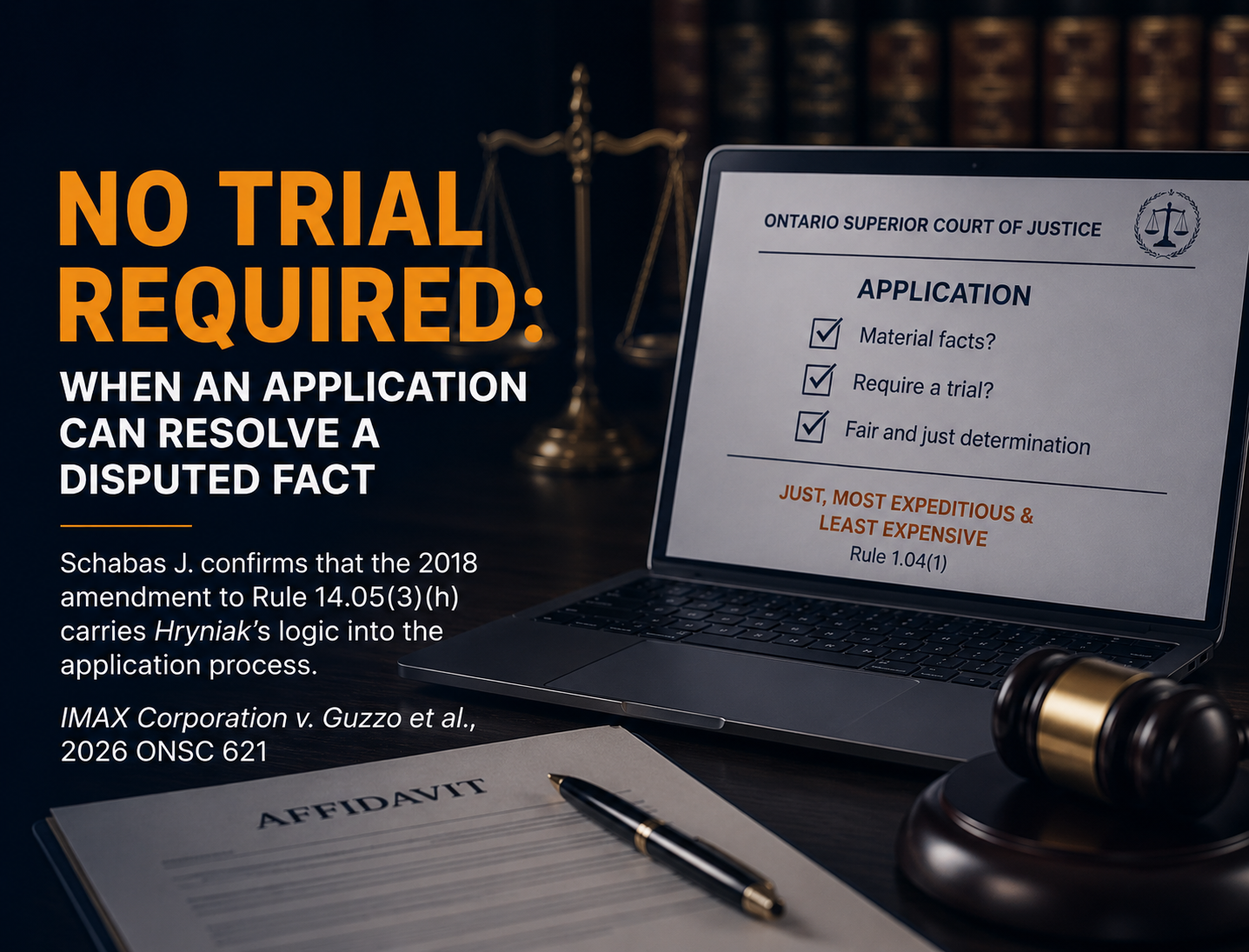
Schabas J. confirms that the 2018 amendment to Rule 14.05(3)(h) carries Hryniak’s logic into the application process — a swearing contest is not, on its own, a ticket to trial.
Case: IMAX Corporation v. Guzzo et al., 2026 ONSC 621 (Schabas J.)
Court File No.: CV-25-00740258 · Heard January 19, 2026 · Released February 2, 2026
Few procedural questions arise as often in commercial litigation as this one: a respondent swears to a version of events that the applicant flatly denies, then argues that the resulting “conflict in the evidence” can only be sorted out at a trial where the judge can look the witnesses in the eye. In IMAX Corporation v. Guzzo, the Superior Court gives that argument short shrift — and in doing so clarifies how the 2018 amendment to Rule 14.05(3)(h) reshaped the application process.
The dispute in brief
IMAX leased projection systems and films to Cinémas Guzzo Inc. in exchange for lease payments, film charges, and a share of box-office revenue. After Cinémas Guzzo repeatedly defaulted, IMAX deferred enforcement in exchange for a personal guarantee from Vincenzo Guzzo — the company’s CEO and co-owner — signed on July 22, 2024, covering all amounts then or thereafter owing.
Cinémas Guzzo kept defaulting. IMAX demanded payment on the guarantee, then brought an application for judgment against both the company and Guzzo personally. By the date of judgment the outstanding balance stood at roughly $2.09 million. Critically, neither the amount owing nor the fact that Guzzo signed the guarantee was in dispute.
The defence: an alleged off-the-books assurance
Guzzo’s answer was a single, late-breaking allegation. In an affidavit filed roughly nine months into the enforcement process, he swore that IMAX’s Global President, Mark Welton, had told him the guarantee existed only to reassure IMAX’s auditors and “had no real enforceability.”
The court catalogued the problems with that account. There were no contemporaneous emails, texts, or records supporting it; Guzzo offered no detail of when or how the supposed side deal was struck; and he had never raised it — not when IMAX moved to enforce, not when counsel sent a demand, not when he was served, and not in his own text exchanges with Welton. Welton categorically denied the conversation, on affidavit and on cross-examination. And the guarantee itself contained an entire-agreement clause (Article 8.1) confirming that no representations affecting the guarantor’s liability had been made outside the document.
The procedural battleground: trial or application?
Faced with that record, Guzzo’s counsel argued the conflict between his evidence and Welton’s raised a genuine credibility contest that could only be resolved at a one-day trial. Schabas J. noted the awkward timing of that submission: at a September 2025 case conference, the respondents had agreed the matter could proceed by way of application and recorded no objection to that procedure.
More importantly, the court rejected the premise. Rule 14.05(3)(h) permits the application procedure where it is “unlikely that there will be any material facts in dispute requiring a trial.” Schabas J. emphasized the operative words — requiring a trial — added by amendment in 2018, which replaced the older language barring applications wherever there were “material facts in dispute.”
The Hryniak parallel
This is the decision’s central contribution. Schabas J. drew a direct line to Hryniak v. Mauldin, where the 2010 summary-judgment reforms shifted the test from “a genuine issue for trial” to “a genuine issue requiring a trial.” The 2018 amendment to Rule 14, the court held, serves the same purpose for applications. The rule no longer bars determination of an application merely because a material fact is contested.
The court was careful about the limits of the analogy. An application judge does not inherit the enhanced fact-finding powers in Rule 20.04(2.1) reserved for summary-judgment motions. But following the staged approach in Hryniak, a judge can ask whether the record permits a fair and just determination — including the resolution of a disputed material fact — without a trial. Where it does, that route is preferable in service of the just, most expeditious, and least expensive determination of the proceeding under Rule 1.04(1).
Credibility can be decided on the paper record
On the merits of the swearing contest, the court reaffirmed that demeanour is an unreliable guide to credibility. Drawing on Faryna v. Chorny and the Court of Appeal’s treatment of it in R. v. Kiss, Schabas J. held that the real test is whether a witness’s account is in harmony with the preponderance of probabilities a practical, informed person would recognize as reasonable.
Guzzo’s account failed that test. It was uncorroborated, raised only after a nine-month delay with no explanation, and inherently implausible — there was no rational reason Welton would have given an assurance contrary to IMAX’s interests and damaging to its own position. The court characterized it as a bald allegation lacking credibility and reliability that could be rejected without a trial. And in any event, because of the entire-agreement clause, even a proven representation would not have been a material fact affecting enforceability.
The unconscionability argument
Guzzo’s fallback — that the guarantee was unconscionable — was dismissed on the two-part test from Uber Technologies Inc. v. Heller: inequality of bargaining power and a resulting improvident bargain. Guzzo, a well-educated and sophisticated businessman with access to legal advice, who was invited to comment on the guarantee and whose own counsel returned the signed document, came nowhere near establishing the first element. Nor was the bargain improvident: it was offered as an alternative to immediate large payments and allowed Cinémas Guzzo to keep receiving films and earning revenue. Improvidence, the court reiterated, is measured at formation — not by reference to later hardship.
Result
IMAX obtained judgment against both Cinémas Guzzo and Guzzo personally for the full outstanding amount, with pre-judgment interest under the lease agreement and post-judgment interest under the Courts of Justice Act. Costs submissions were directed if the parties could not agree.
Takeaways for litigators
- A swearing contest is not an automatic trial. Post-2018, an application judge may resolve a disputed material fact on the record where a fair and just determination is possible. Plan your application materials — and your responses — as if the merits will be decided then and there.
- Put your best foot forward. As with summary judgment, parties are expected to lead their full evidentiary case. A respondent who holds back a key allegation, or surfaces it late, invites the inference that it is an afterthought.
- Entire-agreement clauses carry real weight. Article 8.1 meant that even a proven oral assurance would not have been a material fact. A well-drafted no-representations clause can take an entire defence off the table before credibility is ever reached.
- Demeanour is overrated; probability is not. Faryna v. Chorny and Kiss remain the touchstones. Frame credibility submissions around the inherent plausibility of the account and its consistency with the documentary and digital record — not the witness’s presence in the box.
- Mind the case-conference record. Agreeing that a matter may proceed by application, then arguing for a trial, undercuts credibility on the procedural question. Take a consistent position from the first appearance.
- Unconscionability is a high bar for sophisticated parties. Uber’s two-part test rarely assists a well-advised commercial actor, and improvidence is judged at the moment of contracting.
Citation: IMAX Corporation v. Guzzo et al., 2026 ONSC 621 (CanLII).
This post is a summary for general information and does not constitute legal advice.
If your business is involved in a commercial dispute, enforcement issue, or application proceeding, speaking with a Toronto commercial litigation lawyer early can help you assess the strongest procedural path before costs escalate.
Contact Ruzbeh Hosseini to discuss your litigation options.